
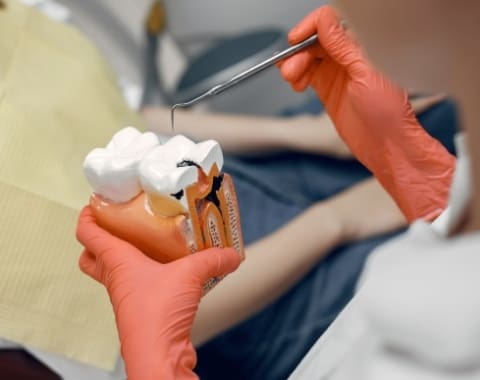
When your dentist mentions a root canal, most people immediately feel their stomach drop a little bit. The procedure’s got this reputation for being this complicated and painful ordeal, but honestly, the reality is way different from what people imagine in their heads. Let me walk you through what actually happens inside a root canal because it might genuinely change how you think about this procedure.
Why Your Tooth Hurts So Much When This Happens
The pain that brings you to consider root canal treatment starts when infection or decay reaches deep inside your tooth, specifically in the pulp chamber. That pulp contains blood vessels and nerves, and when bacteria get in there and cause inflammation, you’re looking at some serious pain. This isn’t just a mild ache either; we’re talking about one of the worst pains people experience because those nerve endings are incredibly sensitive.
When you’re dealing with this kind of pain, you basically have two real options in front of you. You can either remove that infected pulp or you can extract the entire tooth completely. Most dentists, including the team at Manningtree Dental, will recommend saving the tooth whenever it’s actually possible through root canal treatment.
What Actually Happens During the Procedure
Here’s the thing about root canals: they’re not nearly as mysterious as people think when you know what’s actually going on. Your dentist starts by numbing the entire area really thoroughly so you feel pressure and vibration but absolutely no pain. This numbing is crucial because your teeth respond better to an anesthetic when they’re properly numbed.
Access and Removal Phase
Once you’re completely numb, your dentist accesses the pulp chamber inside your tooth. They create a small opening in the crown of the tooth to reach the pulp inside, but it’s not this huge hole that people imagine. It’s actually a carefully planned access point that’s sized exactly for their instruments.
Then comes the part that most people misunderstand about the whole process. Your dentist removes the infected or inflamed pulp tissue carefully using specialized instruments. These instruments are designed to be gentle but really effective at removing all the diseased material. The dentist takes their time ensuring they remove everything because if any infected tissue stays behind, the problem just comes back.
Key aspects of this phase include:
- Careful removal of all diseased pulp material that’s causing infection
- Thorough cleaning of the entire pulp chamber area
- Careful assessment of how deep the canals go and their complexity
- Using specialized endodontic instruments designed for this specific work
- Multiple irrigation cycles to flush out debris and bacteria thoroughly
- Final verification that all infected tissue is completely removed
Shaping and Filling
After removing the pulp, they shape the empty canal really carefully. The canals inside your tooth aren’t straight tubes like you might imagine them to be. They’re often curved, sometimes they have multiple branches going off in different directions, and they can be quite challenging to navigate through. This is where advanced technology and real skill actually make a huge difference.
Why Advanced Dental Care Makes Root Canals Better
Modern root canal treatment uses technologies that make the procedure way more effective and faster than it was just a few years ago. Digital imaging shows your dentist exactly where the canals are and how they’re shaped before they even start working. This precise knowledge and advanced dental care prevent mistakes and ensure the treatment is thorough.
The technological innovations in contemporary endodontic practice include:
- Digital 3D cone beam imaging for precise canal mapping and clear visualization
- Electronic apex locators that measure exact canal depth with real accuracy
- Rotary instruments that are designed for efficient and safe canal shaping
- Ultrasonic tips that help navigate calcified and really difficult canals
- Nickel-titanium files that are more flexible and much less prone to breakage
- Continuous flow irrigation systems that clean the entire canal space thoroughly
- Advanced operating microscopes that magnify the work area considerably
- Real-time monitoring technology throughout the entire procedure for safety
Some offices use electronic apex locators and these tell your dentist exactly how deep to go inside the canal. This prevents accidentally over-filling or under-filling the canal space. These small technological advances actually make huge differences in success rates and patient comfort.
Your dentist fills the empty canal space with a biocompatible material called gutta-percha. This rubber-like material seals the canal completely, which prevents any future infection from happening. They fill the entire canal from the very tip all the way back to where the canal meets the pulp chamber.
Finally, they seal the access opening and restore the tooth. Sometimes this means a simple filling works fine. Other times, the tooth needs additional restoration like a crown to protect it long-term since the tooth becomes more brittle after losing its pulp.
Why Extraction Seems Easier But Actually Isn’t
When someone suggests just extracting the problematic tooth instead of doing root canal treatment, it sounds simpler honestly. Pull the tooth out, problem’s gone immediately, right? Extraction is faster, and in that moment, it might seem more affordable.
But here’s what people don’t realize until it’s actually too late: replacing an extracted tooth costs significantly more than saving the tooth with root canal treatment. Once you lose a tooth, you need to replace it with an implant, bridge, or partial denture. All of these options cost considerably more than root canal treatment and a crown combined.
Beyond the financial aspect though, keeping your natural tooth is genuinely better for you. Nothing replaces a natural tooth perfectly, not even implants. Your natural tooth has roots that stimulate your jawbone, keeping it strong and healthy. Implants do this reasonably well, but nothing actually matches your real tooth.
Long-Term Benefits of Keeping Your Natural Tooth
The advantages of preserving your tooth through root canal treatment include:
- Maintaining normal jawbone density without progressive bone loss over time
- Preserving your natural biting force and chewing efficiency completely
- Keeping proprioceptive feedback that artificial teeth cannot replicate
- Avoiding the need for future tooth replacement procedures down the line
- Maintaining your facial structure and profile appearance naturally
- Keeping your natural tooth sensations and neural connections intact
- Reducing cumulative dental costs over your entire lifetime significantly
- Preventing complications from adjacent teeth shifting and moving
You also maintain normal biting force and sensation throughout your life. Your natural tooth connects to your nervous system in ways artificial replacements simply cannot achieve. Chewing feels normal and natural. Your jaw develops normally without the gaps that come from missing teeth.
What Happens After Your Root Canal Treatment
After your root canal treatment is done, you’re probably going to feel some tenderness for a few days, and honestly, that’s completely normal. Don’t worry about it because it’s totally manageable with over-the-counter pain medication you can grab at any pharmacy. Here’s the thing, though: most people get back to their normal activities the very next day without running into any major issues.
What to Expect During Your Recovery
Your recovery timeline typically follows this pattern, and you should know what’s coming:
- First 24 hours: You might feel mild tenderness or sensitivity in the treated area, but it’s manageable
- Days 2-3: You’ll notice a significant reduction in discomfort and swelling overall, which feels great
- Week 1: Most normal activities can resume without any real restriction, so you’re basically back to normal
- Weeks 2-4: The tooth continues its internal healing process steadily beneath the surface
- Before 6 weeks: Your crown placement appointment gets scheduled for permanent protection of the tooth
Here’s something important to know: your tooth will need a crown eventually to protect it properly long-term. This usually happens a few weeks after the root canal, which gives you plenty of time to recover first before the next step. That crown restores full functionality to your tooth completely, so you can chew normally again.
Debunking Root Canal Myths
Root canals don’t cause pain; they actually relieve it completely. Yes, the procedure involves working inside your tooth, but with modern numbing, you shouldn’t experience any pain during treatment. You feel pressure and vibration, not actual pain.
Root canals don’t fail that often in modern dentistry, honestly. Modern success rates consistently exceed ninety percent. Most failures occur when secondary decay happens around an old restoration, not from the root canal treatment itself failing.
The procedure isn’t unusually time-consuming like people think. Depending on complexity, root canals take anywhere from thirty minutes to an hour and a half. That’s not an unusual time investment to save your natural tooth.
FAQ
1. Will my tooth feel different after root canal treatment is complete?
No, once the crown is placed, your tooth functions completely normally. You might notice it feels slightly different initially, but that adjustment happens within just a few days.
2. Can a tooth ever need another root canal after the first one?
Rarely, this is pretty uncommon in most cases. If it does happen, it’s usually because new decay developed around the restoration, not because the original treatment actually failed.
3. How long will the tooth last after root canal treatment and care?
With a proper crown and good care, your treated tooth can last your entire lifetime.